


Raman spectroscopy is based on a photonic process in which the incident radiation is dis-persed by the sample. This latter is perturbed leading to vibrational and rotational transitions. In general, the Raman spectrum is interpreted like a vibrational one, providing information very similar to the infrared spectroscopy, although the Raman active vibrations are not always the same as those excited with infrared radiation. A Raman vibration mode is active if there is a change of polarizability of the chemical bonds or the considered molecule, which in turn results in the generation of induced dipolar momentam. Its application fields are very broad: semiconductors, carbon compounds (graphite, diamond, nanotubes, fibers…), catalysts, pigments, etc.
Raman spectroscopy is based on a photonic process in which the incident radiation is dis-persed by the sample. This latter is perturbed leading to vibrational and rotational transitions. In general, the Raman spectrum is interpreted like a vibrational one, providing information very similar to the infrared spectroscopy, although the Raman active vibrations are not always the same as those excited with infrared radiation. A Raman vibration mode is active if there is a change of polarizability of the chemical bonds or the considered molecule, which in turn results in the generation of induced dipolar momentam. Its application fields are very broad: semiconductors, carbon compounds (graphite, diamond, nanotubes, fibers…), catalysts, pigments, etc.
Available Equipment
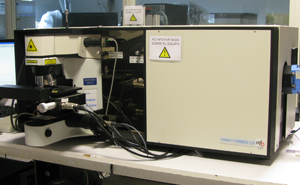
- LabRAM Horiba Jobin Yvon equipped with a confocal microscope and 3 excitation lasers (785 nm red, 532 nm green, and 325 nm UV)
|
Services
|
External | |
|---|---|---|
| OPI / AGE / Universidades | Others | |
|
Micro-Raman Spectroscopy
|
52,60 (€/hour)
|
57,61 (€/hour)
|